
Gandhimathi (Mathi) Padmanaban
Ph.D., Industrial and Systems Engineering, University of Michigan-Dearborn
On the 2026–27 Academic Job Market · CV · gmathi@umich.edu
I build and evaluate adaptable AI systems that are driven and constrained by physical measurements from multimodal data in safety-critical settings involving human interaction. My research sits at the intersection of computer vision, machine learning, and human-centered automation, applied to transportation safety.
I completed my Ph.D. in Industrial and Systems Engineering at the University of Michigan-Dearborn in August 2026, advised by Dr. Fred Feng. My dissertation built tools for driver behavior and driver-bicyclist interaction research. One estimates how closely a vehicle passes a cyclist from a single bicycle-mounted camera using projective geometry, and another detects overtaking vehicles and keeps only the tracks whose movement matches a vehicle passing from behind. I also built a classifier that sorts passing vehicles by injury risk to cyclists and outputs "unknown" when its confidence is low, and a model that identifies aggressive driving from vehicle kinematics and pedal operations. In the lab's LiDAR study of drivers overtaking cyclists, I worked on synchronizing the LiDAR and camera data. Before the Ph.D., I completed an M.S. in Human Centered Design and Engineering on human performance modeling, after five years in the software industry building human-machine interfaces.
My long-term research agenda is to make these systems auditable, so that the people who share roads and other spaces with them are not the ones who discover when they are wrong.
Publications
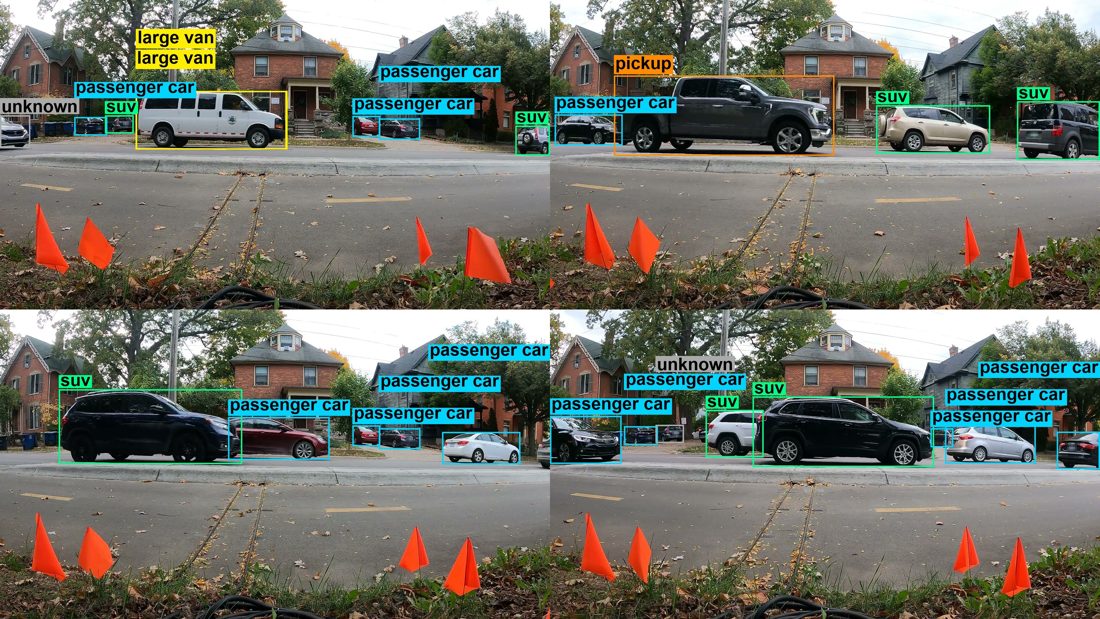
Detection followed by a fine-tuned ViT over six classes defined by injury risk to cyclists. 89% accuracy at held-out sites with no retraining, and an "unknown" output under low confidence rather than a committed label. In preparation, CVPR 2027. Earlier preprint · Code
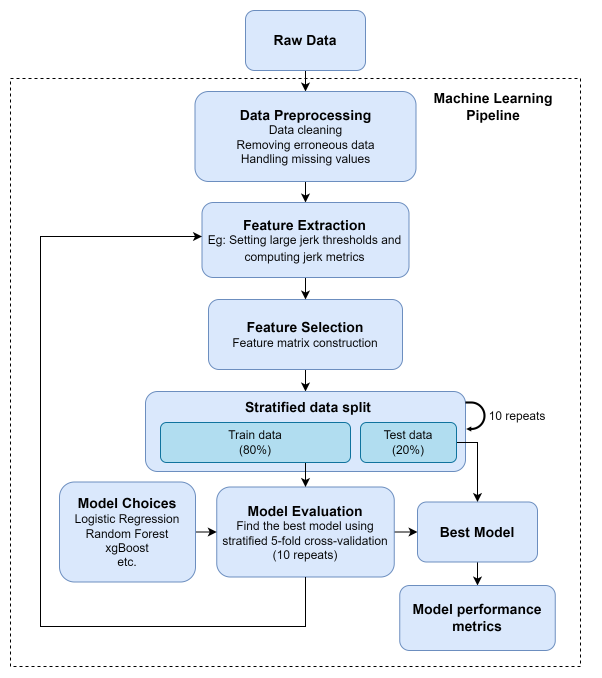
Speed-adjusted jerk thresholds jointly optimized with the classifier, because the same jerk magnitude means different things at 20 and 60 mph. 94% accuracy, AUC-ROC 0.971, across 556 trips and seven vehicle models. Abstract accepted, SAE WCX 2027.
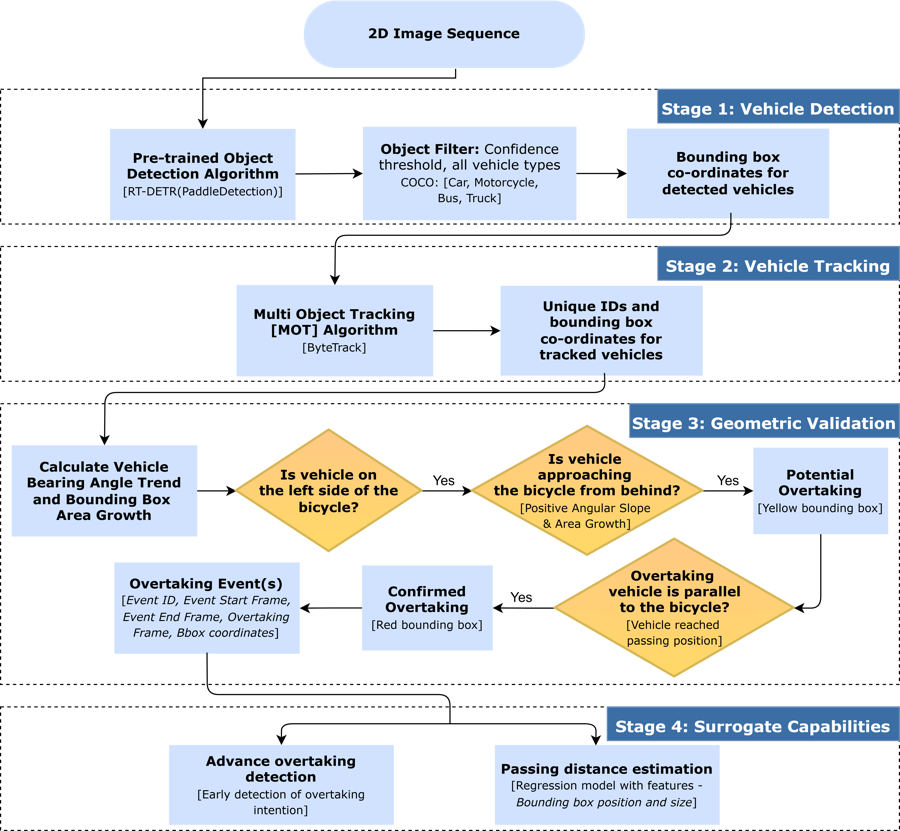
RT-DETR detection and multi-object tracking, followed by three checks from camera geometry that keep only the tracks whose movement matches a vehicle passing from behind. 98.1% recall across 315 annotated events, with a mean of 2.37 s warning before the vehicle passes. Submitted, IEEE Transactions on Intelligent Transportation Systems. Poster, TRB Annual Meeting 2026. NSF PAR · Code
Estimates how closely a vehicle passes a cyclist from bounding-box geometry derived from the pinhole camera model. 0.126 m mean absolute error, and R² = 0.812 when re-fitted on the Waymo Open Dataset. Poster accepted, International Cycling Safety Conference 2026. Journal manuscript in preparation. Details
Surrogate safety measures for drivers overtaking cyclists, from high-resolution LiDAR. Transportation Research Board Annual Meeting, 2026. NSF PAR
Ph.D. dissertation, University of Michigan-Dearborn, 2026. Advisor: Dr. Fred Feng. Deep Blue
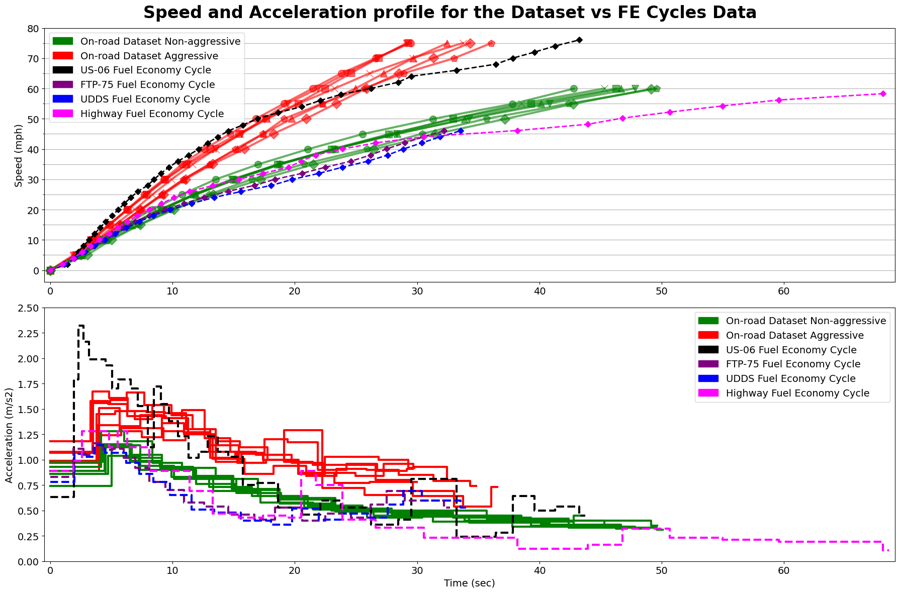
Whether the standardized cycles used to certify vehicles represent on-road driving. US06 approximates aggressive acceleration but overstates deceleration intensity, and the milder cycles overestimate it as well. WCX SAE World Congress Experience, 2025. SAE Technical Paper 2025-01-8605. DOI
AutomotiveUI '21 Adjunct, ACM, 2021, pp. 142-147. DOI
M.S. thesis, University of Michigan-Dearborn, 2021. Deep Blue
Research Software
Automated measurement of vehicle-bicyclist interactions with a physical plausibility check on detector output. Python. GitHub
Injury-risk vehicle classification that abstains under low confidence. Python. GitHub
Machine learning platform for digital twin modeling of biological dynamics in space environments; Global Finalist, NASA Space Apps Challenge 2023. Python. GitHub